The Hennepin County Electronic Poll Pad (Ballot Printing) Pilot Documentation
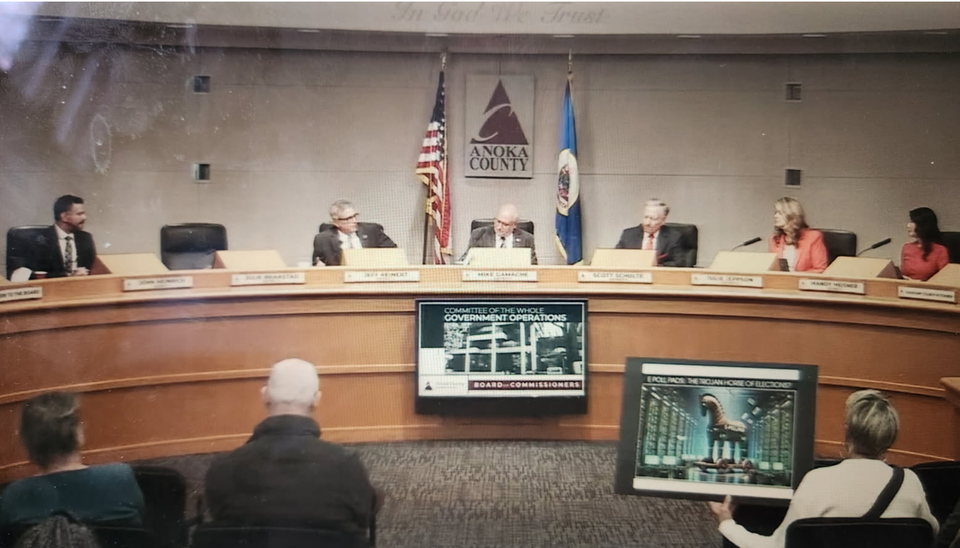
This article focuses on records requests the writer did with Hennepin County, although the main point is that counties can choose not to purchase electronic poll pads to begin with, and even if they do, every municipality (city/town) has the choice whether (or not) to use them. This is the case until the Minnesota Legislature changes the rules (or administrative rules are added by the MNSOS) on same...
In 2025 I published a pamphlet titled Simon’s Sensors: The Secret of the iPads, which includes an expanded version of this story.
Previous articles about electronic poll pads can be reread here (Isanti votes no), here (Oak Grove cancels agreement with Anoka County), and here (how to switch to paper poll books / rosters to check in voters).

At its core, after thinking about the rollout of electronic rosters (iPads with embedded software from KNOWiNK), which began in 2016, to well over half of Minnesota’s counties (and many of the municipalities within those counties), I aimed to learn more about the current status of the technology.
In reviewing contracts that my home county, Hennepin County, had with the vendor, KNOWiNK, I discovered that a new pilot program had been run in 2024. At the start, I didn’t know that for sure, all I had was a proposal for a pilot program with costs, about $27,000, for a list of items, including ballot printers.
Any election judge (poll worker) in Minnesota will be able to tell you that the current iPads cannot print ballots. But what if they could by adding a ballot printer? It seemed that KNOWiNK was already or soon to be providing this capability, if indeed what I was gathering from the proposal was accurate.
I used data requests through the Hennepin County data portal as well as direct emails to members of the roughly 30-person election staff for Hennepin County.
Finally, after some months, it was confirmed that a pilot was run. However, since the pilot was “not completed”, it had been decided that no further information about its success or failure would be shared—this was disappointing after months of waiting. Were these ballot printers even used? How many were used? (The proposal quoted five, but that was only a proposal.) If they were, where were they used? How many ballots were printed? Were any of the printed ballots cast by voters?
I am still debating whether I should like to take further action on this, including filing suit, to force this information to be disclosed. It could be said that I was temporarily exhausted as the current records request or FOIA process can become for ordinary people, including me. And so, the public only learned, through my writing on same in Simon’s Sensors: The Secret of the iPads, that there remains uncertainty about the pilot and the reasons for it, including the reasons that it was not highlighted by either the county or the Office of the Secretary of State as something to look forward to.
I doubt many residents of Hennepin County were aware that ballot printers may have been used on-site in polling locations, attached to the iPads (or somehow networked to them) to enable ballots to be printed. I further doubt that many Hennepin County residents are aware that in 2024 Hennepin County violated the law for about 40 days of the 46-day absentee ballot period by not providing balanced absentee ballot boards. About 200,000 absentee ballots were processed during that period for the general election of November 5, 2024. The court offered no remedy apart from requiring Hennepin County to use balanced absentee ballot boards for the remaining few days of the absentee election timeframe. As far as I know, no one lost their job. More importantly, none of the approximately 200,000 ballots processed in violation of state statute were re-examined.
Is such a flagrant violation of the law in Hennepin County (relating to absentee ballot processing) relevant for my inquiry into the electronic poll pad ballot printers?
For more ideas on how to improve elections locally - start here (Local).
Member discussion